the intervention layer of robotics
why robots do not need perfect autonomy to become useful
The dominant question in robotics has been: how do we make the policy better?
That question has produced enormous progress. Robot learning has moved from narrow, task-specific systems toward generalist policies trained on increasingly diverse datasets. Open X-Embodiment, for example, brought together data from 22 robot embodiments and hundreds of skills, helping show that experience can transfer across robots rather than staying trapped inside one platform [1].
But deployment creates a different problem.
A robot can be impressive in a benchmark, or even succeed on a task 95 or 99 percent of the time, and still be operationally unreliable. Real deployments are long-horizon. They involve repeated decisions, changing objects, imperfect lighting, humans entering the workspace, occlusions, wear, latency, and states that were underrepresented or absent from training.
The right deployment question is therefore not:
When will robots stop failing?
It is:
What should happen when they do?
I think that question points to a missing piece of the robotics stack: an intervention layer between autonomous policy execution and the physical world.
The purpose of this layer is simple: detect when autonomy is no longer trustworthy, stop or pause the policy, route control to a recovery mechanism, recover the task, and return control to autonomy. Today that recovery mechanism can be a human. Over time, more of it can become automated.
The important part is that a failure no longer has to terminate the deployment.
1reliability is not the same thing as autonomy
Suppose a long-horizon robotic task requires 100 sequential decisions. If each decision is independently correct 99 percent of the time, the probability that all 100 decisions are correct is:
$$0.99^{100} \approx 36.6\%$$This is obviously a simplified model. Real robot actions are not independent, and not every local error causes task failure. But the intuition matters: small error rates compound.
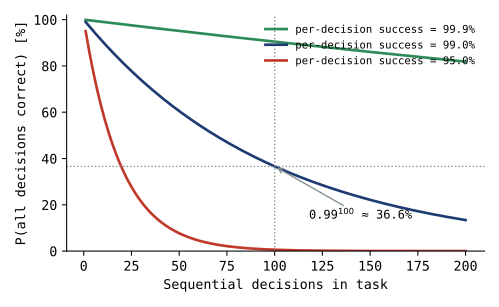
The implication is that a policy can look excellent at the level of individual actions and still be difficult to operate continuously. This is one reason I think the robotics industry may be over-indexing on autonomy as the primary deployment metric.
The end customer usually does not care whether every action was generated autonomously. They care whether the box was packed, the part was inserted, the shelf was stocked, or the machine stayed running. That suggests a more useful metric:
$$\text{System Reliability} \neq \text{Policy Reliability}$$A system can be more reliable than the policy inside it if it has a mechanism for catching and recovering failures. If an autonomous policy succeeds with probability $p$, and an intervention system successfully recovers a fraction $r$ of the remaining failures, then a simple model of system success is:
$$P(\text{system success}) = p + (1-p)\,r$$So an 80% policy combined with a mechanism that successfully recovers 95% of its failures would produce:
$$0.80 + (0.20)(0.95) = 0.99$$Again, that is not a claim about any deployed Northstar system. It is the reliability math behind the architecture.
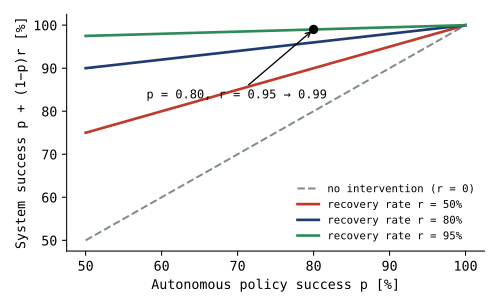
The goal of intervention is not to pretend the underlying model is better than it is. It is to make the whole system robust enough to operate while the model is still improving.
2the idea is not new. treating it as infrastructure might be.
Interactive robot learning has studied human corrections for years.
DAgger, introduced by Ross, Gordon, and Bagnell in 2011, addressed a fundamental problem in imitation learning: a learned policy visits states induced by its own mistakes, not only the clean states shown in an offline demonstration dataset. DAgger repeatedly collects expert actions on states visited by the current policy and aggregates them back into the training set [2].
That idea is extremely relevant to deployed robots. The most valuable data may not be another perfect demonstration from the center of the training distribution. It may be the corrective action required after the learned policy has already put itself into a bad state.
Later work made intervention more selective. ThriftyDAgger, for example, introduced a switching policy that asks for human help in states judged sufficiently novel or risky. In its reported tasks, the method achieved 100% execution success with interventions enabled and explored how a human could supervise a fleet rather than one robot continuously [3].
Human-in-the-loop RL systems push in a similar direction. HIL-SERL uses teleoperated demonstrations, then allows a human to intervene during online robot learning. Importantly, the intervention burden is designed to decrease as the policy gets better [4].
So the core ingredients already exist in research:
- a robot policy acts,
- a supervisor detects risk or error,
- control switches,
- a corrective trajectory is produced,
- that trajectory can improve the policy.
What I think is still underdeveloped is treating this as a deployment primitive rather than only a training technique.
3what the intervention layer actually does
A useful intervention layer has at least four responsibilities:
- Observe the robot and its environment.
- Decide when autonomy should no longer retain control.
- Route and execute recovery.
- Record the failure and recovery as structured data.
At Northstar, the system we are currently building is still human-assisted.
A human monitor watches the robot through an external camera positioned to provide a first-person-like view of the task, together with two wrist-camera streams. When the monitor determines that the autonomous policy is failing, the monitor sends a stop/intervention request to a relay. The relay instructs the robot to stop autonomous execution and routes the session to a remote operator.
The operator uses VR controllers. The operator's hand pose is sent to the relay, where inverse kinematics converts that pose into commands the robot can execute. The robot sends camera streams and joint positions back through the relay to the operator, closing the teleoperation loop.
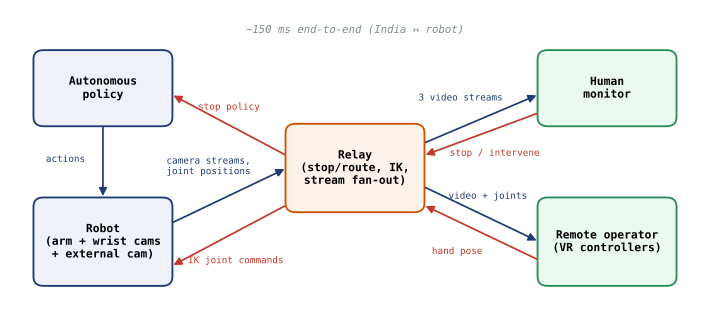
We have operated this loop from India with roughly 150 ms of end-to-end latency in our current setup. The exact recovery time varies substantially by task and failure type, which is why I do not think "average intervention duration" is a meaningful number until we have a much larger deployment dataset.
The current monitoring process is human-assisted rather than fully automated. That is intentional. If the purpose of an intervention layer is to decide when an autonomous system should surrender control, false negatives matter. A system that confidently fails to recognize its own failure can be worse than one that admits uncertainty.
4a failure should become a training example
The intervention layer is interesting as reliability infrastructure. It becomes much more interesting when the intervention itself is treated as data.
For each intervention, we can record information such as:
- the task and subtask being attempted,
- when the failure began,
- why the failure was classified as a failure,
- robot joint positions around failure onset,
- camera observations before and during failure,
- when the monitor requested intervention,
- when policy control stopped,
- when the teleoperator took over,
- the corrective trajectory,
- when the task returned to a recoverable state,
- when autonomy resumed.
The resulting example is not simply $(\text{state}, \text{expert action})$. It is closer to:
$$\text{normal execution} \rightarrow \text{failure onset} \rightarrow \text{failed state} \rightarrow \text{corrective trajectory} \rightarrow \text{recovered state}$$That is a particularly useful slice of the state distribution because it is generated by the policy's own weaknesses. A large pretraining dataset tells a robot what successful behavior looks like across many situations. Intervention data tells it:
Here is exactly where your current policy broke, and here is how a human got you out.
That distinction is important.
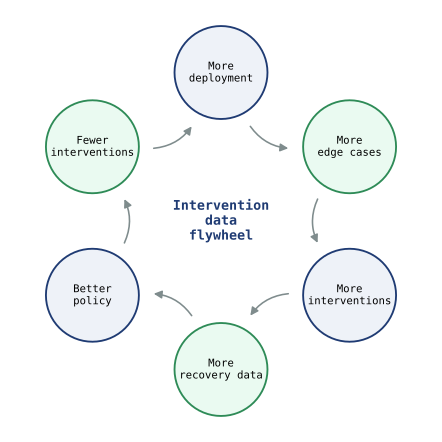
This is closely related to the motivation behind DAgger and corrective imitation learning: the states generated by the learner's own behavior are often different from the states in the original expert dataset [2]. Work on corrective demonstrations has also shown that targeted corrections can be more useful than simply collecting more randomly sampled demonstrations under some data regimes [5].
In a deployed fleet, this process can become continuous. More deployment creates more edge cases. More edge cases create more interventions. More interventions create more recovery data. Better recovery data improves the policy. A better policy requires fewer interventions.
The intervention burden should therefore decline if learning is working.
5what failures actually look like
"Robot failure" sounds dramatic. Most failures are not. Often they are mundane distribution shifts. A few representative examples:
- double grasp
- A robot is sorting garments and attempts to pick one item from a pile. Friction causes two pieces of fabric to come up together. The policy was trained primarily on clean single-object grasps. It may continue as if it holds one garment, causing every downstream step to become invalid. A human can separate the garments, restore a familiar state, and hand control back.
- misaligned insertion
- A robot attempts to insert a connector or component but approaches a few millimeters off-axis. A rigid policy may repeatedly push against the edge, increasing force without making progress. An operator can slightly retract, rotate, realign, insert, and then return control.
- slipped object
- A manipulated object begins slipping from the gripper. The policy's observation may lag the physical change or fail to classify the grasp as unstable. A human can catch the slip early, regrasp, and continue.
- occluded workspace
- Another object, worker, tool, or part temporarily blocks a critical camera view. The policy is now acting with degraded perception. The appropriate intervention might not be complex manipulation at all. It may simply be to pause, reposition, or wait until the state is observable again.
- novel obstacle
- A mobile manipulator encounters a cart, pallet, cable, or temporary fixture in a location that was not represented in training. The policy may oscillate, stop indefinitely, or choose an unsafe path. An operator can move through the novel configuration and return the robot to a state the policy understands.
These are exactly the kinds of states that are difficult to enumerate in advance. The physical world is an adversarial generator of edge cases.
6failure detection will probably become automated before recovery does
The weakest part of a human-assisted system is obvious: requiring a person to continuously watch every robot does not scale. Fortunately, failure detection itself is becoming an active research area.
AHA, introduced in 2024 and published at ICLR 2025, trained a vision-language model specifically to detect and reason about manipulation failures. The authors reported that its failure feedback improved downstream task performance when integrated into several robotic frameworks [6].
More recent work is pushing toward online detection. RoboFailRing, published at ACL 2026, evaluated failure detection across more than 6,000 simulated failure trajectories spanning 81 manipulation tasks. It reported 80% average success on out-of-distribution failure detection and substantially faster detection than its comparison baseline; the authors also evaluated reasoning on real-world systems [7].
Foresight, released in June 2026, takes a different route: it uses action-conditioned world-model representations to monitor long-horizon manipulation and is trained using only final task-level success or failure labels, rather than requiring dense failure annotations [8].
These systems are not evidence that failure detection is solved. They are evidence that the "monitor" itself can become a learned component. That suggests a plausible progression:
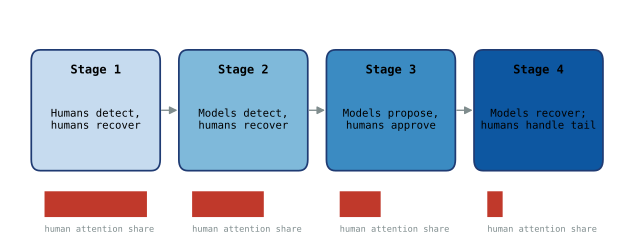
- Stage 1: Humans detect and recover failures.
- Stage 2: Models detect failures; humans recover them.
- Stage 3: Models detect failures and propose recovery; humans approve or edit.
- Stage 4: Models detect and recover common failures; humans handle the tail.
The human does not need to disappear for the economics to improve dramatically. The fraction of events requiring human attention only needs to fall.
7one operator should not map to one robot
This is where intervention becomes a fleet problem. If a teleoperator is permanently driving one robot, we have built remote labor, not autonomy. The scalable model is different: robots operate autonomously most of the time, and operators are a shared recovery resource.
A simple queueing approximation makes the economics clear. Suppose:
- each robot requires $\lambda$ interventions per hour,
- the average intervention takes $s$ seconds,
- an operator should stay below target utilization $u$ so there is enough headroom for bursts.
Then a rough operator capacity is:
$$N \approx \frac{u}{\lambda s / 3600}$$This is not a fleet sizing formula; real systems need to account for correlated failures, geographic latency, task specialization, safety constraints, shift schedules, and queueing delay. But it shows which variables matter.
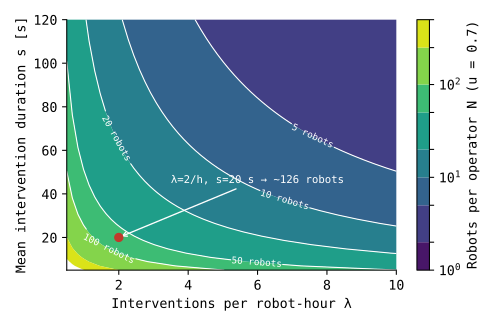
For example, if interventions average 20 seconds and each robot asks for help twice per hour, the direct workload is only about 40 seconds of operator time per robot-hour. In a world where failures are sparse and uncorrelated, one human can support many autonomous systems.
The long-run objective is therefore not just to reduce policy failure rate. It is to reduce:
$$\text{human seconds required per robot-hour}$$That may be one of the most important deployment metrics for general-purpose robotics.
8the intervention layer creates a new optimization target
A robotics company traditionally optimizes policy success rate. An intervention system introduces a richer set of operational metrics:
- failures per robot-hour
- percentage of failures detected
- time from failure onset to detection
- time from detection to control handoff
- recovery duration
- recovery success rate
- interventions per operator-hour
- human seconds per robot-hour
- percentage of repeated failure modes
- percentage of interventions that later become autonomously recoverable
This changes how we think about progress. Imagine two policies.
Policy A succeeds autonomously 96% of the time but fails unpredictably and catastrophically. Policy B succeeds autonomously 92% of the time, but its failure modes are easy to detect, easy to recover, and rapidly disappear after collecting corrections.
Which system is easier to deploy? The answer is not obvious from task success rate alone. Deployability depends on the joint system:
$$\text{policy} + \text{monitoring} + \text{handoff} + \text{recovery} + \text{learning}$$That is the intervention layer.
9why i think this matters now
Robotics is currently getting better at two things simultaneously.
First, generalist robot policies are getting more capable because of larger and more diverse datasets, better architectures, and better training procedures [1]. Second, the research community is beginning to treat uncertainty, failure detection, human intervention, and recovery as first-class problems rather than afterthoughts [3][4][6][7][8].
Those trends should converge. The future robot stack may look less like:
$$\text{Model} \rightarrow \text{Robot}$$and more like:
$$\text{Model} \rightarrow \boxed{\text{Reliability / Intervention Layer}} \rightarrow \text{Robot}$$The box in the middle observes what the policy is doing, determines whether autonomy should retain control, brings in assistance when required, logs the event, and gradually learns to resolve more failures on its own.
This is conceptually similar to fault tolerance in other engineering systems. We did not make distributed software reliable by assuming servers would never fail. We built retries, monitoring, failover, redundancy, alerts, rollback, and incident response around imperfect components. Robotics will need its own version of that philosophy.
A robot is not reliable because its policy never fails. A robot is reliable when failure is an expected state that the system knows how to handle.
10the end state is not more teleoperation
It would be easy to misunderstand the intervention layer as a bet on humans remotely operating robots forever. I think the opposite is more interesting. The teleoperator is a bootstrapping mechanism.
Human recovery provides a high-quality answer to a difficult question:
Given that the robot has already reached this unusual failure state, what sequence of actions returns it to a useful state?
Repeated across a fleet, those answers become a recovery dataset. Eventually the system should recognize recurring failure modes. Then it can retrieve similar recoveries, predict corrective actions, ask a human for approval, and finally execute some recovery classes autonomously. The loop becomes:
$$\text{Failure} \rightarrow \text{Human recovery} \rightarrow \text{Recovery data} \rightarrow \text{Recovery policy} \rightarrow \text{Autonomous recovery}$$Humans keep moving outward toward the tail of the distribution. That is the part of the intervention thesis I find most compelling.
The purpose of human intervention is not to hide the weakness of autonomy. It is to turn the failures of autonomy into the data required to improve it.
∎conclusion
Robotics does not need to wait for perfect autonomy. It needs systems that can survive imperfect autonomy.
A robust intervention layer can do three things at once:
- keep a robot productive when the policy encounters a state it cannot handle,
- make one human a shared reliability resource across a fleet,
- convert failures into targeted training data.
The underlying policy should keep improving. The monitor should become increasingly automated. Recovery models should absorb recurring corrections. Human intervention should become rarer. But the broader architecture may remain.
Autonomy handles the common case. The intervention layer handles the tail.
And for physical AI, the tail is where deployment gets difficult.
references
- O'Neill, A. et al. Open X-Embodiment: Robotic Learning Datasets and RT-X Models. ICRA 2024. doi:10.1109/ICRA57147.2024.10611477.
- Ross, S., Gordon, G., and Bagnell, D. A Reduction of Imitation Learning and Structured Prediction to No-Regret Online Learning. AISTATS 2011.
- Hoque, R. et al. ThriftyDAgger: Budget-Aware Novelty and Risk Gating for Interactive Imitation Learning. CoRL / PMLR 2022.
- Luo, J., Xu, C., Wu, J., and Levine, S. HIL-SERL: Precise and Dexterous Robotic Manipulation via Human-in-the-Loop Reinforcement Learning. 2024. arXiv:2410.21845.
- Jain, A., Kolb, J., Abbess, J. M., and Ravichandar, H. Evaluating the Effectiveness of Corrective Demonstrations and a Low-Cost Sensor for Dexterous Manipulation. 2022. arXiv:2204.07631.
- Duan, J. et al. AHA: A Vision-Language-Model for Detecting and Reasoning Over Failures in Robotic Manipulation. ICLR 2025. arXiv:2410.00371.
- Ying, C., Du, L., Shu, Y., and Cheng, P. RoboFailRing: Retrieval-Augmented and Language Grounding Failure Detection for VLM-enabled Robotic Manipulation. ACL 2026. doi:10.18653/v1/2026.acl-long.602.
- Zhang, H. et al. Foresight: Failure Detection for Long-Horizon Robotic Manipulation with Action-Conditioned World Model Latents. 2026. arXiv:2606.23085.