remote embodiment and the globalization of physical labor
teleoperation, automation, and labor arbitrage in a task-based model
This is the readable version. The full working paper — with the CES environment, all four proofs, the empirical design, and the appendix on task-level variables — is in the pdf. JEL: F14, F16, J23, J42, O33.
§abstract
Remote teleoperation allows labor located in one country to perform physical tasks in another through robotic capital located at the destination. I call the resulting production mode remote embodiment and study its implications for trade, labor demand, and the geography of production. In a two-country task-based model, a physical task can be performed by destination labor, conventional offshore production, or a hybrid technology combining destination robot capital with source-country operator attention. The human input required by the hybrid technology falls with autonomy.
The model yields four results. First, lower robot and network costs, a wider international wage gap, and greater autonomy expand the set of physical tasks exposed to cross-border labor competition. Second, autonomy is complementary to remote embodiment at the adoption margin but substitutes for source-country operator labor at the intensive margin; operator employment therefore depends on whether fleet expansion outpaces the decline in human attention per robot-hour. Third, remote embodiment can reshore physical production while leaving the associated control service offshore. Fourth, platform labor-market power determines how much of the cost advantage reaches operators rather than customers or capital owners.
Robotics may first make physical labor internationally tradable and only later make it unnecessary.
1the constraint that is weakening
The modern geography of work reflects a basic technological constraint: information can move cheaply across borders, but physical action generally cannot. A software developer in Bengaluru can write code for a firm in San Francisco because both the process and the deliverable are digital. A worker who picks a box, inserts a component, inspects a machine, or clears a jam has historically needed to be where the object is.
Remote teleoperation weakens that constraint. The robot stays at the destination worksite. Cameras and robot state cross the network outward; perception, judgment, and motor commands cross it inward. The labor crosses the border as information even though the task remains physical:
$$\text{destination robot capital} + \text{source-country labor} + \text{network} \;\longrightarrow\; \text{local physical output}$$This is economically distinct from both conventional offshoring (production moves to cheap labor; the good crosses the border) and full automation (marginal human input goes to zero). Remote embodiment occupies the space between the two, and it expands the set of tasks exposed to international labor competition beyond what classic offshorability frameworks anticipate (Blinder 2007; Grossman and Rossi-Hansberg 2008; Baldwin and Dingel 2021).
2the economic unit: human attention per robot-hour
The human role in a remote-embodiment system ranges from continuously driving one robot, through shared autonomy, to intervening only when a policy fails, to handling only novel tail events once a recovery model absorbs recurring failures. The relevant labor unit changes across those regimes:
| operating regime | human role | labor unit |
|---|---|---|
| continuous teleoperation | performs the task throughout | operator-hour per robot-hour |
| shared autonomy | supplies goals or difficult segments | assisted minutes per robot-hour |
| exception intervention | recovers failures on demand | intervention-seconds per robot-hour |
| autonomous recovery | handles only novel tail cases | human seconds per rare event |
The main operating variable is therefore not an autonomy label. It is
$$H = \text{human seconds required per successful robot-hour}$$A continuously teleoperated robot has $H \approx 3{,}600$. An intervention system may have a much smaller value if failures are infrequent and rapidly recovered. $H$ is what connects engineering progress to labor demand: lower $H$ reduces variable labor cost, raises the number of robots one operator can support, expands adoption — and reduces the source-country labor used per robot. The model represents this with an autonomy parameter $A$ that lowers operator hours per unit of output.
Task characteristics — observability, controllability, latency tolerance, reset intensity, safety externality, social locality, standardization — behave like iceberg trade costs. An operator supplies an hour of effort; only a fraction arrives as useful physical output.
3the model
Two countries, destination $H$ with wage $w_H$ and source $S$ with wage $w_S < w_H$. A continuum of physical tasks $z \in [0,1]$, ordered so that higher $z$ is harder to teleoperate. Each task can be produced by destination labor at unit cost
$$c_H = w_H \ell$$or by remote embodiment at unit cost
$$c_E(z, A) = r + w_H m + w_S h(A) + \tau(z)$$where $r$ is robot capital and software cost per unit, $m$ is destination maintenance and reset labor per unit, $h(A)$ is source-country operator hours per unit with $h'(A) < 0$, and $\tau(z)$ is task-specific remote-control friction with $\tau'(z) > 0$. The firm chooses remote embodiment when $c_E \le c_H$, which defines a cutoff
$$z_c = \tau^{-1}\!\left[\, w_H(\ell - m) - r - w_S h(A) \,\right]$$Tasks below $z_c$ are remotely embodied; tasks above it stay with destination labor.
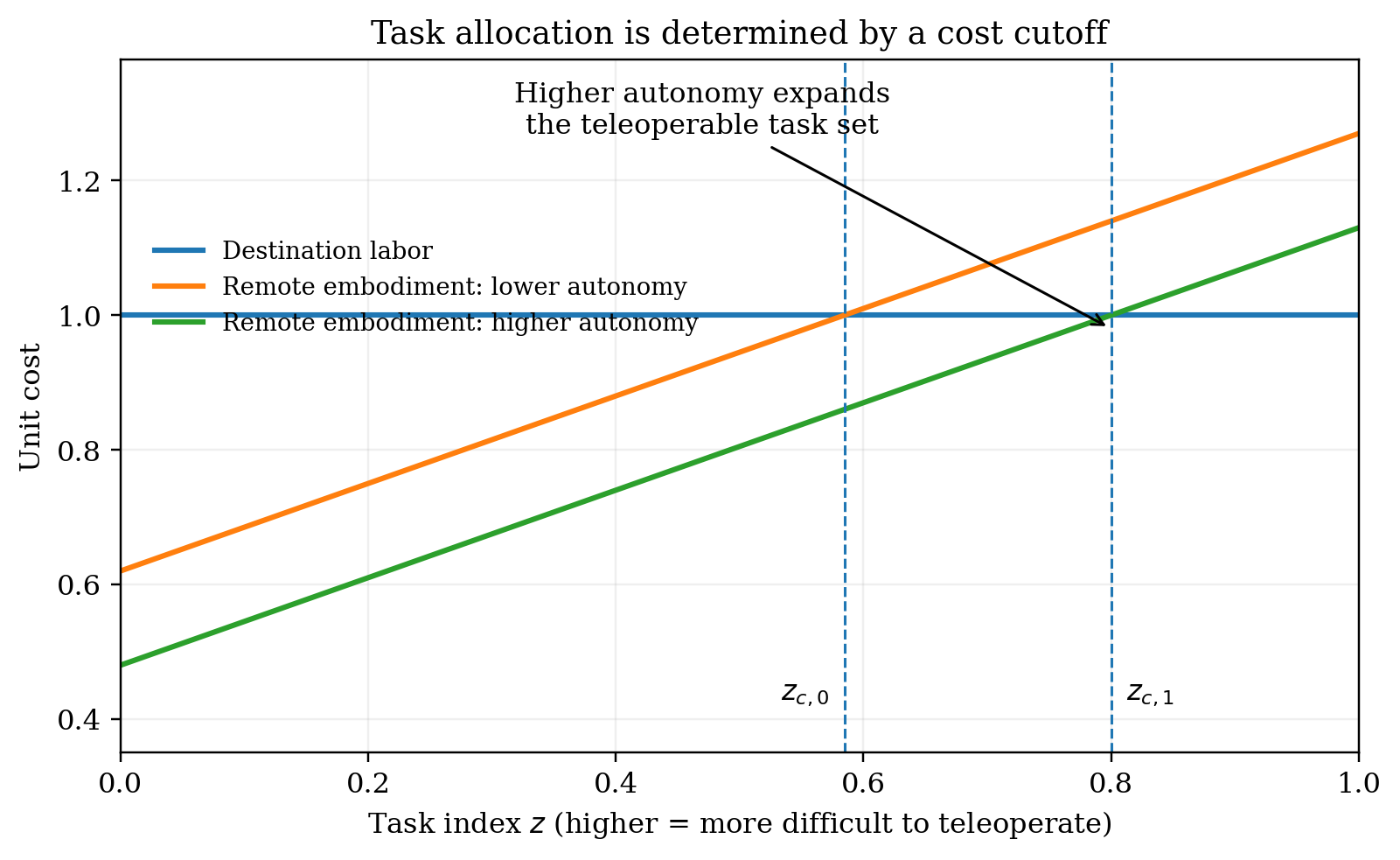
With an interior cutoff and $\ell > m$:
$$\frac{\partial z_c}{\partial A} > 0, \qquad \frac{\partial z_c}{\partial w_H} > 0, \qquad \frac{\partial z_c}{\partial w_S} < 0, \qquad \frac{\partial z_c}{\partial r} < 0$$Greater autonomy, a higher destination wage, a lower source wage, and a lower robot cost each expand the range of physical tasks assigned to remote embodiment.
This formalizes labor arbitrage. A wider international wage gap does not automatically make every physical task tradable; it raises the maximum remote-control friction the firm is willing to absorb. The direct cost saving on an embodied task is $w_H \ell - c_E$, and robot cost, local support, latency, risk, and platform fees all absorb part of the wage wedge before it matters.
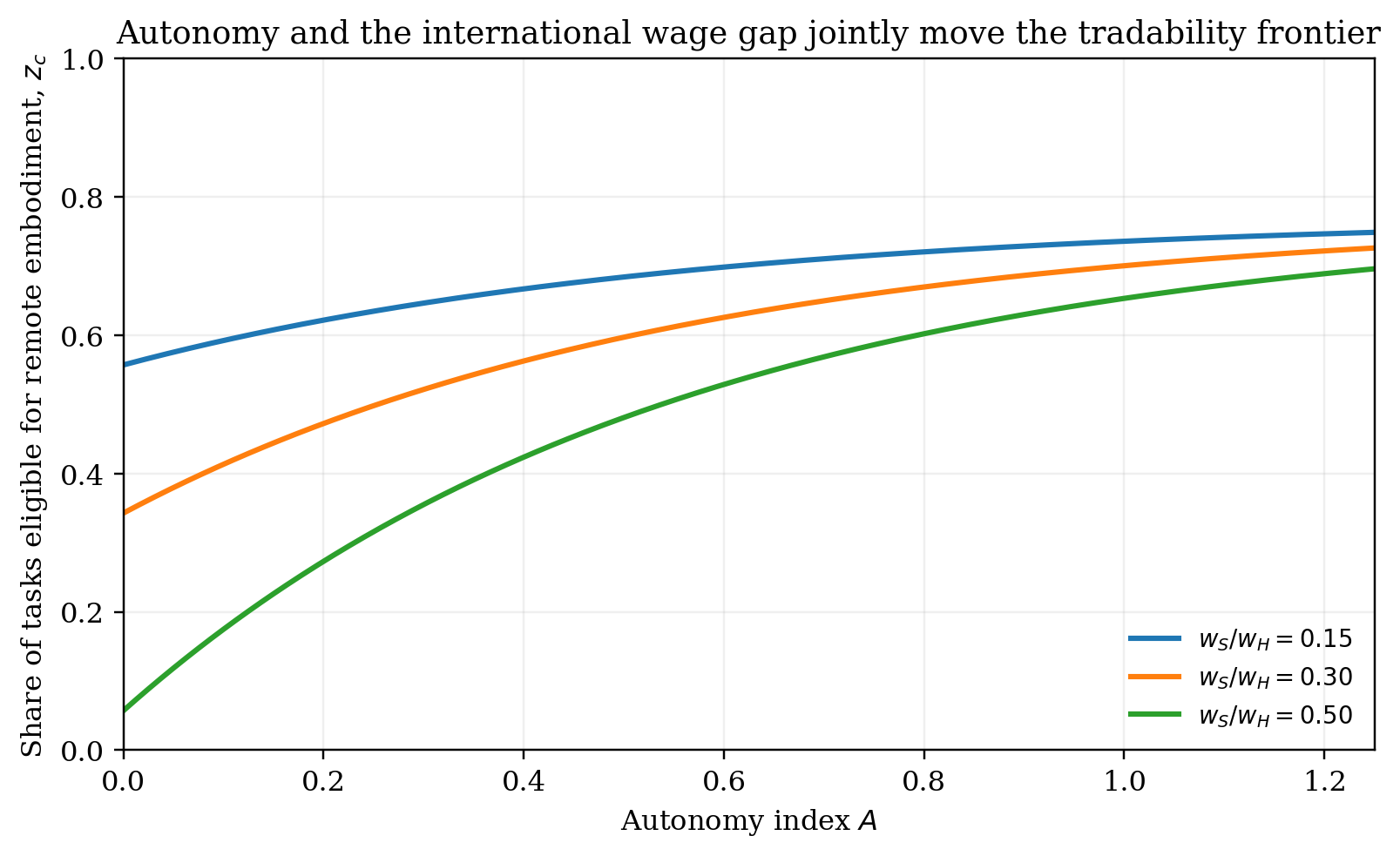
The curves converge as autonomy rises because operator labor becomes a smaller share of total cost. Labor arbitrage is most central when teleoperation is labor-intensive; in the limit the technology becomes ordinary automation and source-country operator demand approaches zero.
4scale versus displacement
Source-country operator labor is operator hours per unit times remotely embodied output, $L^E_S(A) = h(A)\,Q_E(A)$, so
$$\frac{d \ln L^E_S}{dA} = \frac{d \ln h}{dA} + \frac{d \ln Q_E}{dA}$$The first term is negative: autonomy reduces operator hours per unit. The second is generally positive: lower costs raise output on existing embodied tasks and move new tasks into the embodied set.
Source-country operator employment rises with autonomy if and only if
$$\frac{d \ln Q_E}{dA} > -\frac{d \ln h}{dA}$$i.e. when the percentage expansion of remotely embodied output exceeds the percentage decline in operator labor per unit.
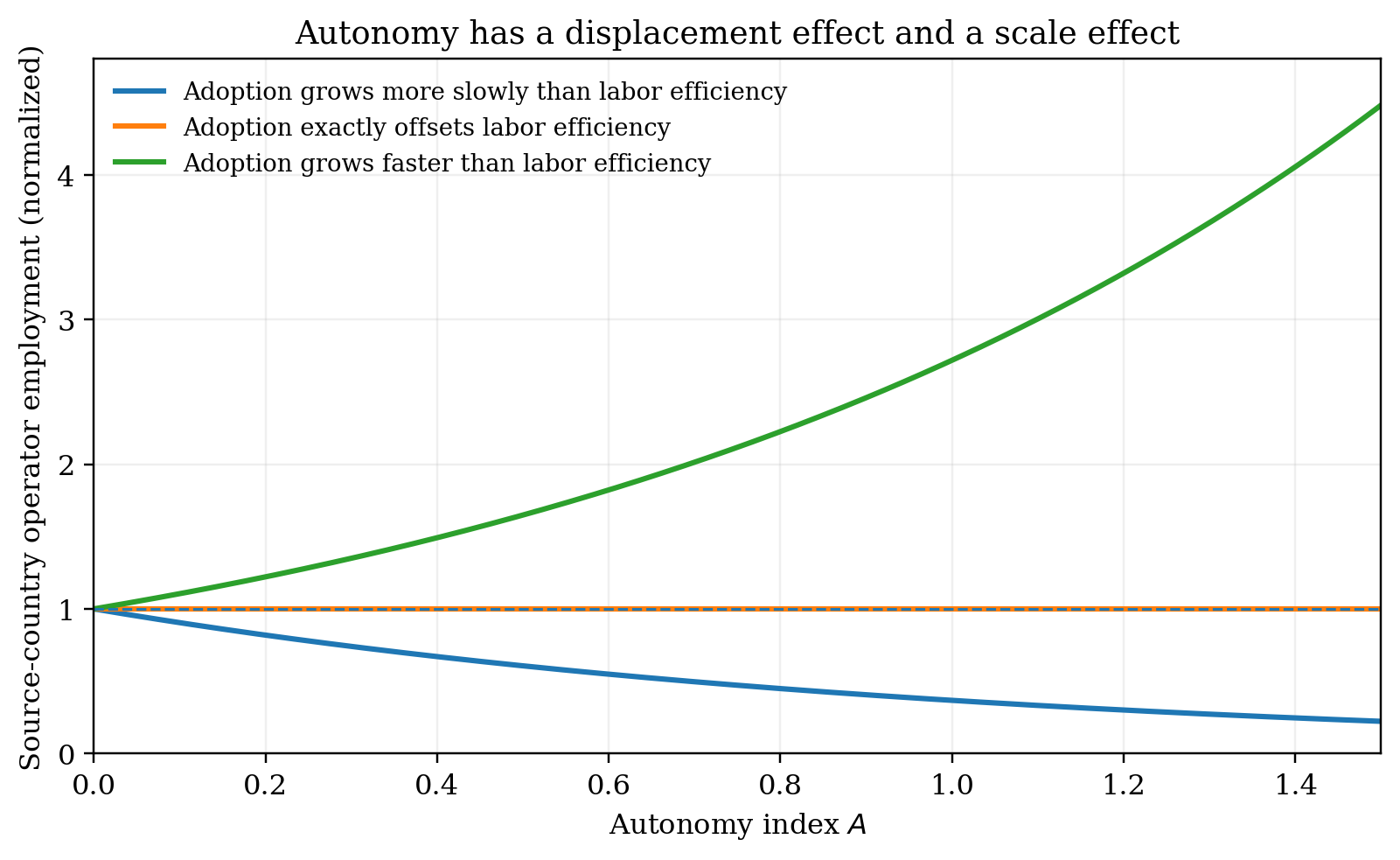
This separates the short-run and long-run narratives. Early autonomy gains can raise operator employment if they make deployments economical across a rapidly expanding fleet. Later gains can reduce it if robot-hours grow slowly relative to the fall in human attention. The employment path can be hump-shaped even when the technology improves monotonically. The model rejects any unconditional claim that teleoperation either creates or destroys source-country jobs.
On the destination side, moving a marginal task to remote embodiment changes local labor by $m - \ell < 0$ holding output fixed — the direct displacement effect — but lower task costs raise final output, and installation, maintenance, safety, and physical-reset work expand with the fleet. The net effect is ambiguous in aggregate and concentrated in task space, mirroring the displacement-versus-productivity distinction in Acemoglu and Restrepo (2019).
5who captures the surplus
Remote embodiment will likely be organized through platforms that integrate robots, authenticate operators, route tasks, and bill customers. If a platform faces upward-sloping source labor supply $L(w) = \bar{L} w^{\varepsilon}$ and chooses the wage to maximize $(v - w) L(w)$, where $v$ is the marginal revenue product of operator labor, the first-order condition gives
$$w = \frac{\varepsilon}{1 + \varepsilon}\, v$$The operator receives a share $\varepsilon/(1+\varepsilon)$ of marginal revenue product. Less elastic labor supply produces a larger markdown and lets the platform capture more of the labor-arbitrage surplus.
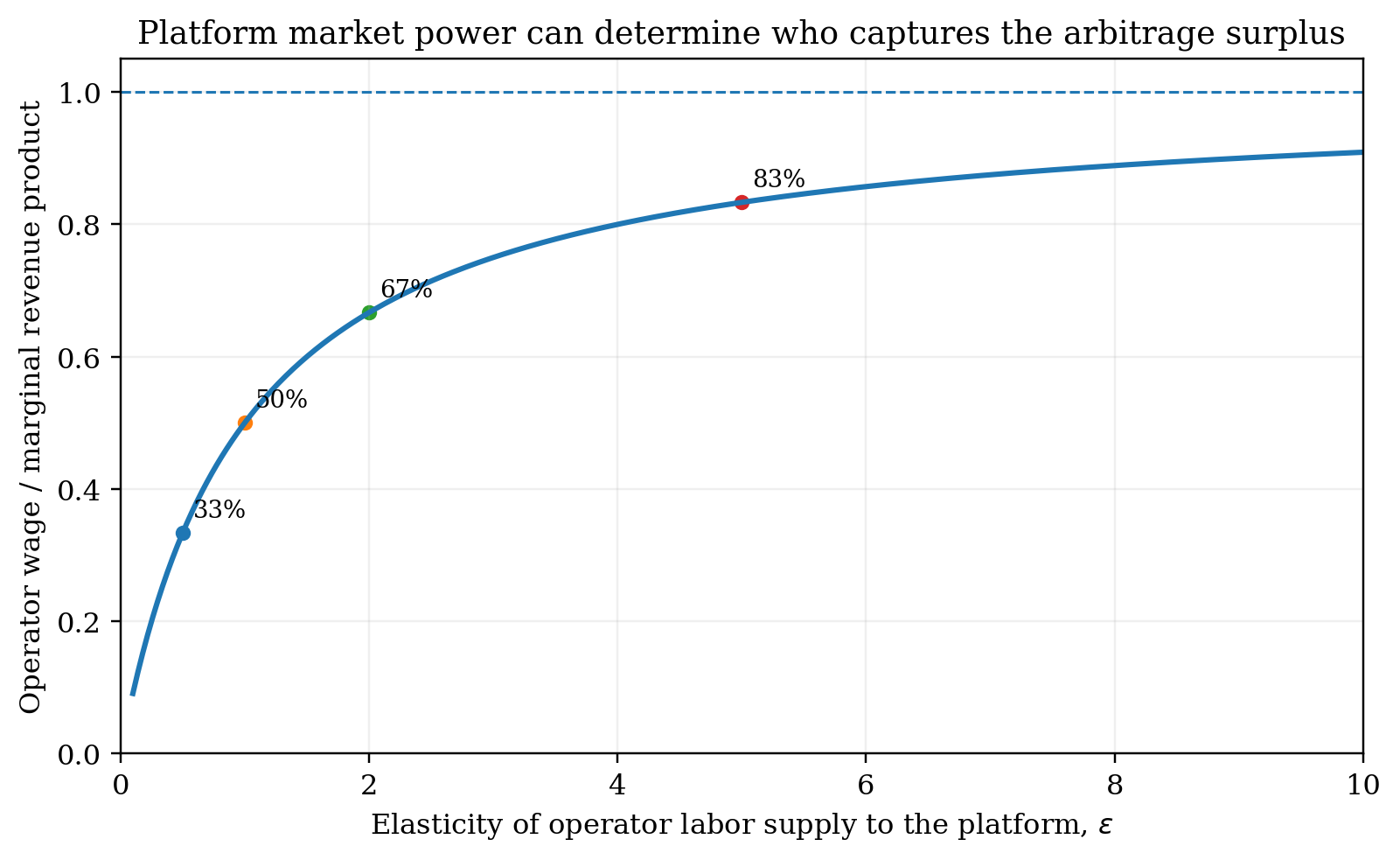
Standard monopsony economics (Manning 2003), but the application matters: improvements in robot productivity need not pass through proportionately to operator wages. Platform design also affects unpaid time — if operators are paid only for active intervention-seconds but must remain available between events, measured wages overstate compensation per committed hour.
6a third production geography
Add conventional offshore production at unit cost $c_O = w_S b + t$, where $t$ bundles shipping, inventory, coordination, and tariffs. The firm now picks the minimum of $\{c_H, c_O, c_E(z,A)\}$. Remote embodiment replaces the shipping friction $t$ with the network-control friction $\tau(z)$ and destination robot cost $r + w_H m$; it is favored when moving the physical process abroad is costly but transmitting control is cheap.
Take a task initially produced offshore, $c_O < \min\{c_H, c_E(z, A_0)\}$. If autonomy rises to $A_1$ or teleoperation friction falls such that $c_E(z, A_1) < c_O < c_H$, the physical production stage moves to the destination country while source-country labor remains employed through the operator input $h(A_1) > 0$.
This is physical reshoring with labor-service offshoring. Capital and output move toward the destination market while control labor stays internationally supplied. A statistic that records plant location will classify the activity as reshored even though part of the labor value chain remains offshore.
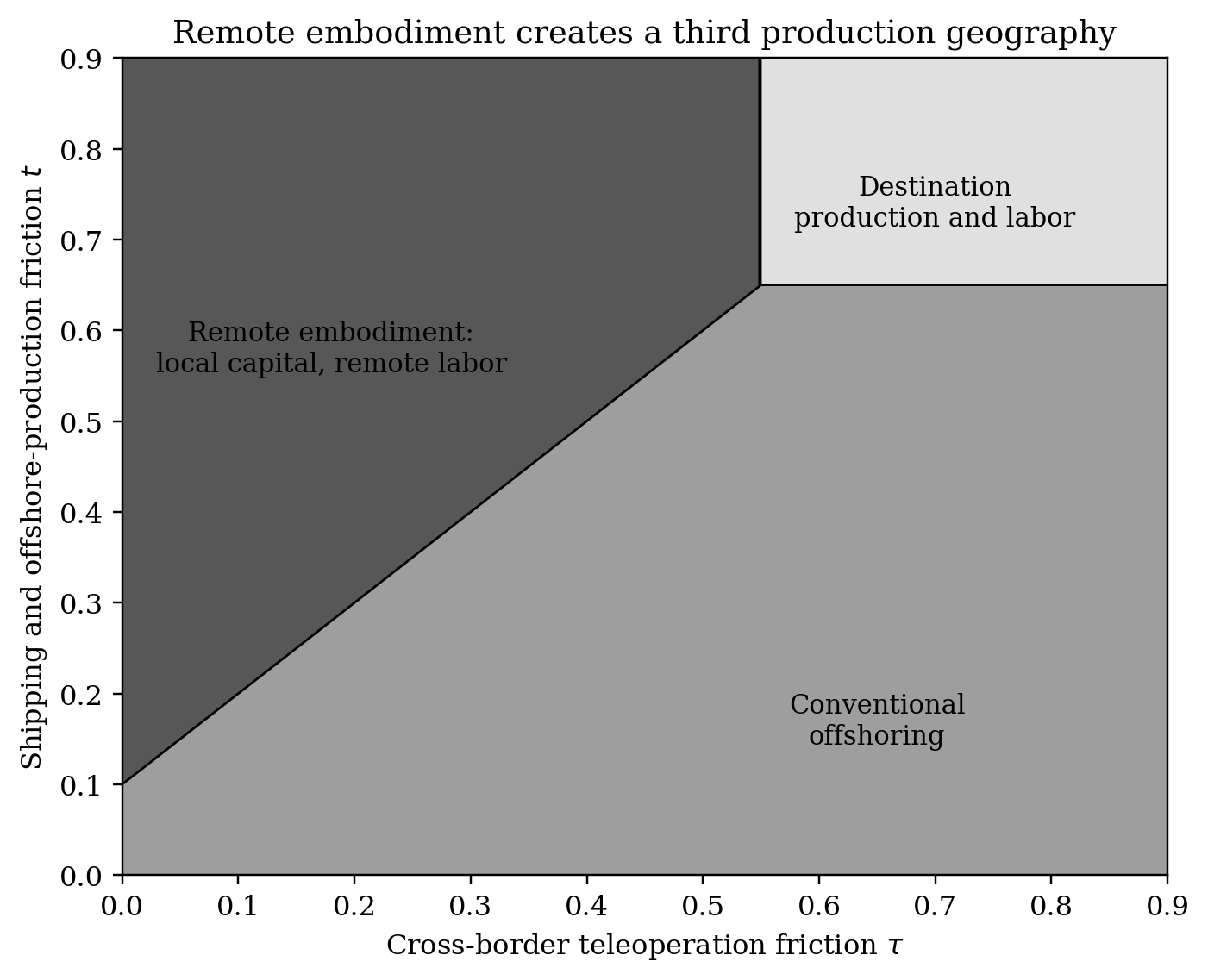
Three implications follow. Robot adoption need not mean substituting capital for all foreign labor — it can replace foreign physical production while retaining foreign control labor. Destination production becomes more resilient to shipping disruptions while acquiring a new dependence on networks, cloud infrastructure, cybersecurity, and foreign operator pools. And trade statistics may record the imported input inconsistently: as a business-service import, a platform fee, an intra-firm service, or not at all.
7how to test it
The data to test this do not yet exist in standardized public form, so the paper specifies them rather than substituting illustrative numbers for evidence. The pieces:
- a task-level Remote Embodiment Potential Index (REPI), $\sum_k \omega_k Z_{ok}$, seeded from O*NET task characteristics with weights learned from teleoperation trial outcomes — and distinguishing continuous-teleoperation potential from intervention potential;
- a firm-level event study around first cross-border teleoperation deployment, with network-latency shocks (new cable routes, cloud regions), exchange-rate shocks, robot-cost exposure, and platform entry as sources of variation;
- commuting-zone exposure built from pre-period occupation shares × REPI × adoption, following the logic of prior trade- and robot-shock designs;
- source-country outcomes that separate gross job creation from wage incidence and job quality: active vs. standby hours, premiums over local outside options, turnover, classification, exposure to deactivation;
- a five-layer dataset: robot session logs, operator records, firm outcomes, task characteristics, and network conditions.
Falsifiable predictions include: adoption is more wage-gap-sensitive when $H$ is high; autonomy expands adoption while cutting operator minutes per robot-hour; source employment rises only where fleet expansion beats the fall in attention intensity; destination losses concentrate in high-REPI, low-complementarity tasks; and operator wage pass-through is lower on platforms facing less elastic supply.
8the dynamic that makes this different
Remote labor generates the data that improves autonomy. Intervention logs identify the states in which a policy fails and the actions that recover it:
$$\text{deployment} \rightarrow \text{human intervention} \rightarrow \text{recovery data} \rightarrow \text{better policy} \rightarrow \text{lower } h(A)$$Source-country labor is therefore both a current production input and a potential input into its own future substitution. That produces a lifecycle:
- labor-arbitrage phase: one remote worker controls one robot
- leverage phase: one worker supports several robots through sparse intervention
- training phase: recurring recoveries are learned from operator data
- tail phase: humans handle only novel or high-risk cases
The model predicts source employment can rise in the leverage phase and fall in the tail phase. Whether operators share in the productivity gains depends on data ownership, reputation portability, profit sharing, and the creation of higher-skill roles — fleet supervision, safety management, robot integration. The technology alone does not decide between a low-road equilibrium of fragmented, monitored piece-rate intervention work and a higher-road one that builds capability. (This connects to the intervention layer post, which describes the engineering side of the same loop.)
9policy and measurement
Remote embodiment is neither ordinary outsourcing nor ordinary automation, so the response has to combine trade, labor-platform, cybersecurity, and workplace-safety tools. Statistical agencies should separately record the location of robot and output, the location of the operator, the control regime, operator seconds and standby per robot-hour, payments to operators and platforms, and where the intervention data is owned. Labor standards need to assign responsibility for safety, wages, fatigue, and incident investigation across jurisdictions, and pay rules need to count mandatory standby. Portable certifications, interoperable control standards, and exportable performance histories raise the elasticity of labor supply to any one platform and shrink the markdown in Proposition 3. Destination adjustment policy should focus on exposed workers and places and tie training to complementary roles; source-country policy should aim beyond low wages toward connectivity, certification, and career paths.
∎conclusion
Remote teleoperation changes the economic meaning of distance for physical work. The international wage gap interacts with robot cost, autonomy, and network friction to determine a tradability cutoff; autonomy cuts human attention per robot-hour while expanding the deployments for which remote embodiment is economical; production geography stops being a binary between domestic production and offshoring; and the distribution of gains is institutional.
The most important empirical variable is therefore not whether a robot is described as autonomous. It is
human seconds per successful robot-hour, measured together with the location and compensation of those human seconds.
The first large global effect of general-purpose robotics may not be the immediate disappearance of physical labor. It may be the conversion of physical action into a cross-border service, followed by the gradual automation of that service.
selected references
- Acemoglu, D. and Restrepo, P. Automation and New Tasks: How Technology Displaces and Reinstates Labor. J. Econ. Perspectives 33(2), 2019.
- Acemoglu, D. and Restrepo, P. Robots and Jobs: Evidence from U.S. Labor Markets. J. Political Economy 128(6), 2020.
- Autor, D., Dorn, D., and Hanson, G. The China Shock. Annual Review of Economics 8, 2016.
- Baldwin, R. and Dingel, J. Telemigration and Development. NBER WP 29387, 2021.
- Blinder, A. How Many U.S. Jobs Might Be Offshorable? Princeton CEPS WP 142, 2007.
- Bonfiglioli, A., Crino, R., Gancia, G., and Papadakis, I. Robots, Offshoring and Welfare. CEPR DP 16363, 2021.
- Brinatti, A., Cavallo, A., Cravino, J., and Drenik, A. The International Price of Remote Work. NBER WP 29437, 2022.
- Datta, N. et al. Working Without Borders: The Promise and Peril of Online Gig Work. World Bank, 2023.
- Grossman, G. and Rossi-Hansberg, E. Trading Tasks: A Simple Theory of Offshoring. AER 98(5), 2008.
- Hoque, R. et al. Fleet-DAgger: Interactive Robot Fleet Learning with Scalable Human Supervision. CoRL 2023.
- International Labour Office. World Employment and Social Outlook 2021.
- Manning, A. Monopsony in Motion. Princeton University Press, 2003.
- Steinhoff, J., Posada, J., and Delfanti, A. Remote Robotics, or the Digital Re-Embodiment of Labour. WOLG 19(2), 2025.